Undergraduate Research Projects
The American Race in an Unequal System
Why La Raza Graduates High School and College at Lower Rates
Written by: Christopher Michael Escobedo Sr.
Introduction
“28% of Latino adults (age 25 and older) currently have an associate degree or higher, compared to 48% of White adults” (Escalante 2025). La Raza graduates’ high school at lower rates than Europeans (Escalante 2025). The topic of my paper is about the connection to the challenges Raza faces completing high school and college. Since lower high school completion denies access to financial aid and college level curriculum, the inequities that Raza deals with from kindergarten through high school accumulates and help explain why Raza students’ complete college at much lower rates than their non-Hispanic white peers. I want to find out what scholars have determined to be factors in high school graduation rates for Raza. Despite rising high school graduation rates, Raza students continue to graduate high school and complete college at lower rates than non-Hispanic white students because many schools remain racially and economically segregated, culturally unwelcoming, and incentivized to give diplomas, so I want to know how we fix this.
What challenges impede Raza from completing high school, which then leads to lower college enrollment, which leads to only 28 percent of Latino adults having a college degree versus 48% of white adults? The answer matters because Latinos are the largest ethnicity in the United States of America along with the fifth largest GDP of the world according to a UCLA article by Barbara Ramos in 2025 and therefore could have a huge positive impact if we are properly educated and given opportunities needed for social, political, and economic advancement. America is the motherland of Raza and therefore they should have leadership positions across the board from congress to corporations profiting from their land and resources. When Raza students are denied equal educational opportunities, it makes it harder for them to graduate high school than their non-Hispanic white peers.
First, I will define La Raza while explaining the historic understanding of Eurocentric views of Chicanos/Latinos/Hispanics using laws and policies created for and against them. Next, I will create a literature review to explain what scholars have discussed about the situation. Then I will analyze the literature and express what I conclude and why. Next, I will give my recommendations and finally, I will conclude by briefly restating the problems, solutions and recommendations and ending them with a call to action.
Definitions
La Raza means the American race. La Raza comes from the early 1900s and was coined from Jose Vasconcelos, a Mexican philosopher and the Secretary of Public Education, in his book La Raza Cosmica, where he explains that in the future, Indigenous Americans will breed with all races to create La Raza. All peoples whose ancestors are from North and South America are the American Race. According to the Census, Hispanics are a sub-category of the white race. According to Raza and the Chicano Movement that parallelled the Civil Rights Movement in the 1960’s fighting to self-identify, our race is Indigenous American. Since we are not a part of the “recognized tribes” of the United States we are not seen as Indigenous Americans. The problem with the word Hispanic is that it means the person’s ancestors are from Spain, which disconnects Raza from the land of America. The problem with the term Latino is that it implies that a person is from Latin countries south of the US border once again disconnecting Raza from part of our Motherland. Since European leadership in America chose to divide the Indigenous American Race into different terms, for this analysis, I will use La Raza when talking about Chicanos, Latinos, and Hispanics.
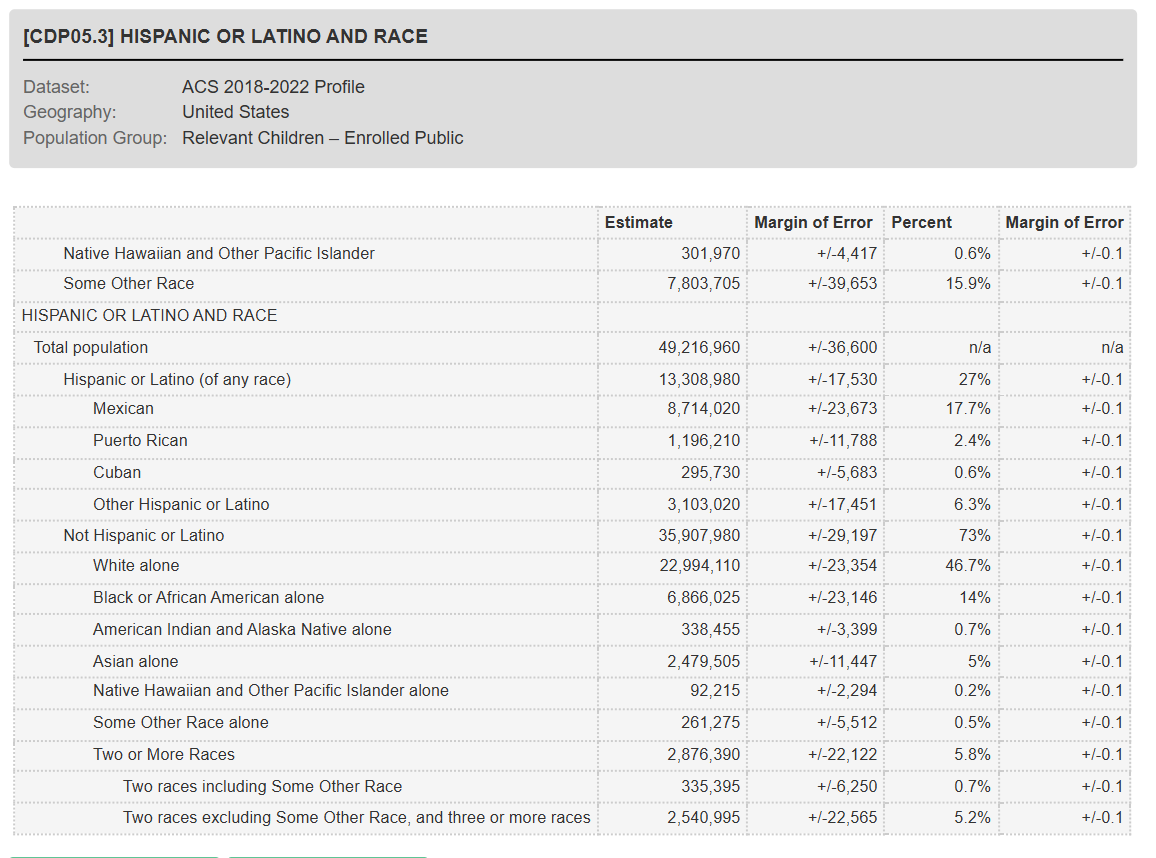
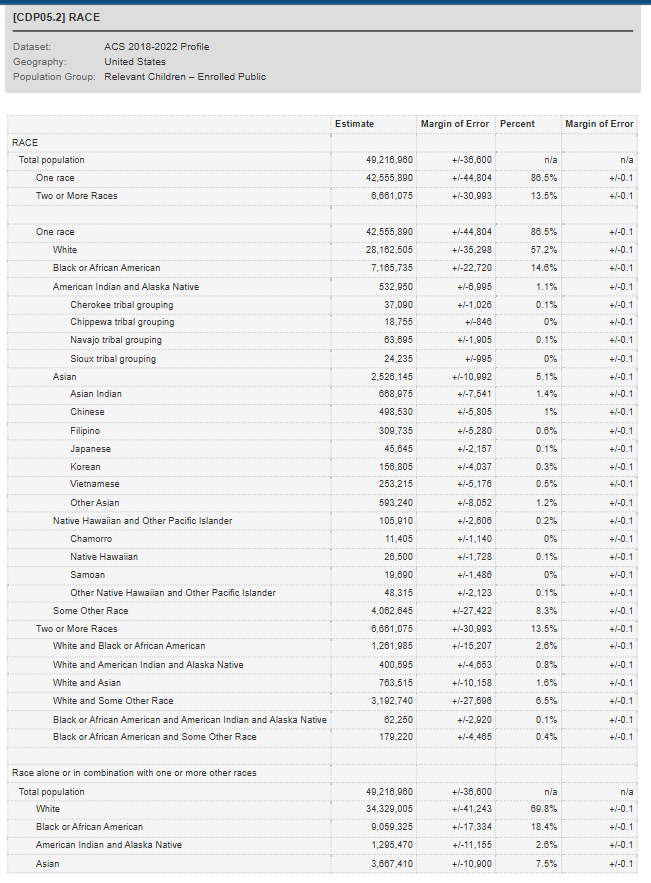
Another important point is that since Hispanic and Latino are ethnicities, they are allowed to be a subcategory of the white race. This is because the Treaty of Guadelupe suggested that Mexicans have white status because at the time you had to be white to be naturalized. Shouldn’t Raza be a part of the American Indian race since that is their actual race? In the two tables below, we get a glimpse of the manipulation and confusion caused by this phenomenon. In graph CDP05.3 it’s easy to see that Hispanic and Latino enrolled students amount to 13,308,980 and whites alone make up 22,994,110. Now look at the next graph CDP05.2 that separates people based on race. Where are the Latino and Hispanic students located within these numbers? I could not make the math work between the two graphs. La Raza means Indigenous American which is known in government treaties as American Indians.
Background of Problem
Indigenous children of the Americas, or Raza, have been continuously persecuted in the public school system since the beginning of the United States. Indigenous children were taken from their families and put into residential schools that taught assimilation and prepared them to become laborers. In 1896, Plessy v. Ferguson created the precedent of what Europeans called “separate but equal” public schools. White schools would teach leadership and be fully funded for success while Mexican Schools would be underfunded with underpaid staff and broken-down buildings. “Mexican Schools” were segregated schools that Europeans would force Mexican students to attend to force them to speak English and assimilate. If Mexican children are being exploited and the rhetoric of society is explicitly racist towards them, then Mexican children would not want to go to school. In 1931 the Alvarez v Lemon Grove case shows an example of this exploitation. The court found that because the Chicano students were considered white, they could not be segregating them because of race (Donato 2019). In 1946 a California court case Mendez v. Westminster declared “Mexican schools” unconstitutional which laid the groundwork for Brown v. Board of Education (Esquibel-Kennedy 2023).
In the article Spanish was Beaten out of Me: White Violence and Mexican Schools in Early-to-Mid Twentieth Century Kansas, author Neill Esquibel-Kennedy says, “The complexities of Brown highlight how 1) the public school system entrenched in racism across the country (not just the Jim Crow South)” (Esquuibel-Kennedy 2023). Brown v. Board of Education was a Supreme Court decision that solidified the ideals of the Constitution to say that separate systems based on race is prohibited in 1954. Also in 1954, Mexican Americans are given equal protection of the Constitution for the first time in the Hernandez V. Texas Supreme Court case. Does this history give insights into why do people who are originally from America decide to get educated less than Europeans? What are the reasons scholars have come up with? What are some remedies for this crisis?
The situation of identity and equal rights in education has continued to be so dire that the Chicano community had to come together to demand changes in society and in school systems across the nation multiple times in the last century. One example would be the school walkouts that took place in San Antonio during the civil rights era. In article written by Casey Nichols in 2023 he states, “These students sought to overcome their marginalized status in the school system and became agents of their own social movement as part of an explosion of protests and demonstrations during the ongoing Civil Rights and Anti-Vietnam War Movements” (Nichols 2023). In Las Angeles on March 28 1968 over 1200 community members showed up at the Board of Education to make 26 demands which included removing administrators and teachers who show any form of prejudice toward Mexican or Mexican American students and another stated “all administrators where schools have majority of Mexican-American descent shall be of Mexican-American decent” (Way 2018).
Corky Gonzales of Colorado created a bilingual Chicano school Escuela Tlatelolco that focused on teaching the youth Indigenous culture and history. Corky was one of the mythic legends of the Chicano Movement who helped organize the 1969 Chicano Youth Liberation Conference that hosted over 1500 people. This was part of the Chicano Movement of the 1960s that delt with education and seem to be the only way a Chicano student could feel welcomed and thrive. Romero (2004) concludes that Chicanos became politically active to create a movement that would bring attention to the economic and political isolation of Raza. Some might argue that this movement for equality in education created motivation that led to higher high school graduation rates. I would argue that graduation rates don’t prove that these movements created the change they were seeking. Schools could have manipulated their data and have been forced to pass students to coerce school metrics.
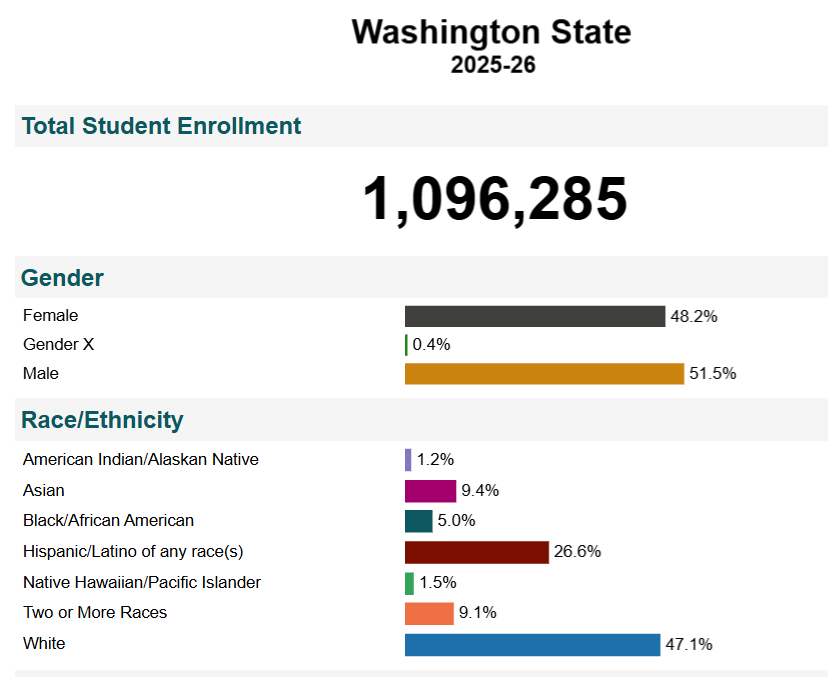
A problem I want to address is lack of Raza in higher education compared to their general population in the public school system in Washington State. For example, according to the National Education for Education Statistics, in Washington State Raza is 26.6 % of the public school system as is shown in graph 1, yet only about 14% of universities in my area of Washington State are Raza (NEES 2024).
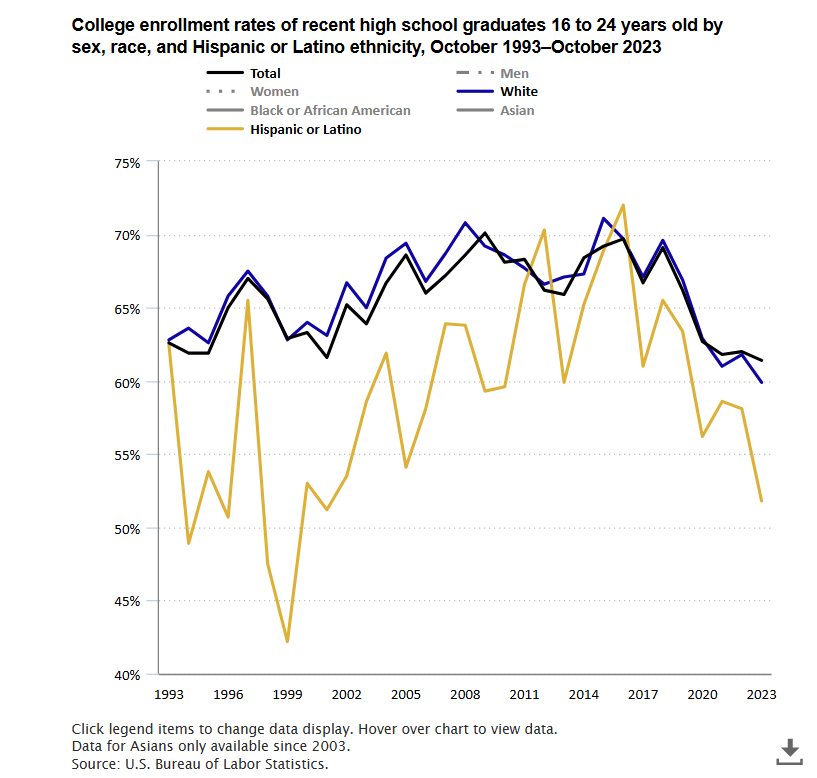
According to the website for the private school of Pacific Lutheran University, which is one of the top ten universities in Washington, only 13% are Hispanic (PLU 2021). At the University of Washington Tacoma, which is a public institution, Hispanic students make up 14% of the students (UWT 2023). Hispanics are only 7% of the University of Puget Sound, which is said to be the 4th best private college in Washington state (UPS 2023). At Western Washington University, Hispanics only make up 10.4% of the student body (WWU 2024). As you see in graph 2, the college enrollment rate of Latino and Hispanic students stays much lower than that of whites for 30 years, with 2012 and 2016 being outliers. This shows the effects of the obstacles Raza faces in the school system.
Another important point is that since Hispanic and Latino are ethnicities, they are allowed to be a subcategory of the white race. This is because the Treaty of Guadalupe suggested that Mexicans had white status because, at the time, you had to be white to be naturalized. Shouldn’t Raza be a part of the American Indian race since that is their actual race? In the two tables below, we get a glimpse of the manipulation and confusion caused by this phenomenon. In graph CDP05.3, it’s easy to see that Hispanic and Latino enrolled students amount to 13,308,980 and whites alone make up 22,994,110. Now look at the next graph, CDP05.2, which separates people based on race. Where are the Latino and Hispanic students located within these numbers? I could not make the math work between the two graphs. La Raza means Indigenous American, which is known in government treaties as American Indians.
In 1980 only 44 % of Raza graduated from high school. By 1990 the percentage grew to 58%. Here we see a big jump in Raza graduating high school, yet these numbers don’t correlate with Raza going to college, as seen in graph 2.
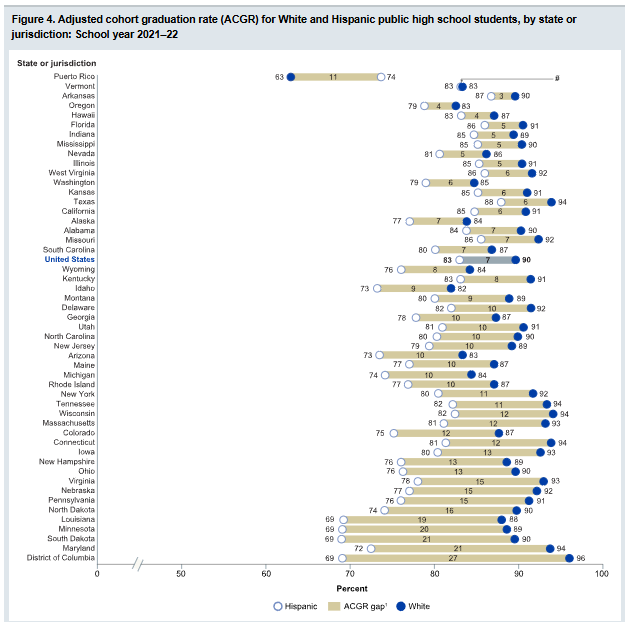
According to the National Center for Education Statistics, “Asian/Pacific Islander students had the highest graduation rate (94 percent), followed by White (90 percent), Hispanic (83 percent) …and American Indian/Alaska Native (74 percent) students” (NCES 2024). Although High School graduation rates continued to climb, since Hispanics have Indigenous blood, the average graduation rate for Raza is 79 percent. In the graph below you can see the graduation rates in Washington State which shows Hispanics graduating at 79% while whites graduate at 85%.
As you can see in figure 4, Raza graduated high school at lower rates in every state of the United States of America.
To help you understand the history of this problem first I want to talk about the General Education Board, then mention a court case that created precedence of “Mexican schools” and finally, teach about some court cases that tried to rectify the problem of segregation in schools. Some of the first public schools were created by Rockefeller to make workers and laborers, not professionals. I believe the quote was “I don’t want a nation of thinkers; I want a nation of workers”. According to Snopes this kind of quote is nowhere to be found but they did find that the advisor to Rockefeller, Fredrick Taylor Gates, who was instrumental in the creation and operations of the General Education Board or GEB, which was a charity that focused on public education in the Southern states of the USA, did write a book in 1916 called “The Country School of Tomorrow”. In this book he says that “We shall not try to make these people or any of their children into philosophers or men of learning, or men of science. We have not to raise up from among them authors, editors, poets or men of letters. We shall not search for […] great artists, painters, musicians nor lawyers, doctors, preachers, politicians, statesmen, of whom we have an ample supply…The task we set before ourselves is very simple as well as a very beautiful one, to train these people as we find them to a perfectly ideal life just where they are” (Kasprak 2023). This quote explains how Europeans wanted to keep Raza and Blacks from becoming professionals, so instead they wanted to teach them how to be happy within the working class.
Literature Review
In my literature review I want to discuss a few books and a couple of articles that explain a few challenges the American Race faces when navigating the U.S. public school system. The themes I want to discuss are the continued segregation of schools, policies and laws affecting Raza, and the demographics of teachers not being representative of the students. I found my books by asking Maribel Galvan, a Masters graduate of the University of Washington, and Director of Arts and Culture for Mi Centro about books that could help my paper. I was given ten books and chose two to help argue my points. I skimmed through the titles of chapters to find the subjects needed, then read through the chapters to confirm and learn more about the problems of the public school system. I found other sources by asking the librarians for help because of the limitations of literature about Raza. Now that our roadmap is drawn out, I will start with Creating a home in schools by Fracisco Rios and A Longoria.
In the book, Creating A Home In Schools Sustaining Identities for Black, Indigenous, and Teachers of Color written by Francisco Rois and A Longoria in 2021, I read about how Covid-19 showed the flaws in many systems including health and education. People of color got sick more because they live in highly populated areas and work in the service industry that has constant physical interaction. According to the book, the education system is a mirror of societal inequities according to the book. They saw this at a macro level of retreating from fighting for the rights of the LGBTQ+ in schools, fighting sexual harassment, and “efforts to disrupt discriminatory discipline policies that negatively affect African American and Latino youth” (Longoria 2021). According to the book desegregation and integration of public schools has retreated since the 1980’s and schools today are as segregated as before Brown v. Board. “White students attend schools that are largely white, While Latinx students attend schools that are largely Latinx” (Longoria 2021). In this quote you can see how segregated American schools are in 2021.
Longoria’s analysis of resegregation after the 1980s supports the theme of school segregation making a comeback and it demonstrates how schools have continued to divide students by race despite segregation being illegal. A news report from MSN in 2025 titled Separate and Unequal Again: The Resegregation of America’s Public Schools written by Jeffrey Kass explains that “studies show that American schools are more racially segregated today than they were in the late 1960s” (Kass 2025). Both Longoria and Kass agreed that segregation is on the rise and Longoria mentions the rhetoric of the failing public school system has created a phenomenon of white charter schools popping up across the country. This continued segregation has polarized the nation into a US versus them scenario where Brown skinned people (who are Indigenous to America) are seen as them.
Other problems discussed in Longoria’s book is the demographics of teachers and how even though the percentage of Latino students increased from 19 to 25 percent between 2003 and 2013, teachers remained over 80 percent white. This mismatch matters because research shows that when teachers are more diverse academic outcomes improve and the cultural relevance gives the students a sense of belonging (Longoria 2021). Latino teachers only went from 6 to 9 percent in this same time (Longoria 2021). Is it the problem that Latinos aren’t getting the degrees needed to be teachers? That’s another problem to research in a different paper but the problem exists and is connected to how welcomed Latinos feel in the public school system. This book made no mention of where this is located but the authors are from Western Washington University. Rios and Longoria taught us that a sense of belonging is important when thinking about educational success.
In the article “Mexican-American resistance to school segregation”, professor of the School of Education at the University of Colorado Ruben Donato along with senior instructor Jarrod Hanson explains past court cases and how the racial classification fluidity over the decades of Raza allowed the court system to exploit loopholes by exploiting legal categories to maintain segregation. Since Mexican Americans were legally classified as white, Indian, and other sometimes a race themselves, judges and school districts redefined statuses to avoid being against the Constitution. This same phenomenon made access to resources and education, and we see the legacy of these practices in high school graduations rates today. National and Washington State data shows that Indigenous and Raza graduate at lower rates than their non-Hispanic white counterparts.
In the article “Barriers to School Success for Latino Student’s” I got a glimpse of some of the barriers found to cause Latino students to underperform and drop out of school. A point made was “while Latino high school graduation rates have increased over the past decade, Latino academic achievement and college completion have fallen behind” (Marrero 2016). Some examples of these barriers shared are school personnel, Latino parent involvement, and school partnerships with families. “Research found that Latino parents want to understand how to best help their children succeed in their studies, but more importantly are focused on engagement that helps their children develop holistically as people and not just within an academic setting” (Marrero 2016).
School personnel can be a barrier if the staff are mostly white and uncultured. In the article they used interviews of Latino students by Schulz and Rubel (2011) where one student said he was speaking Spanish to his mom and the teacher seemed not to like Mexicans. Marrero said that “educators of Latino students should focus on developing trusting relationships, establish high expectations of them, and move away from negative stereotypes and deficit thinking” (Marrero 2016). This negative thinking comes from the implicit bias created from decades of propaganda like “the Brown Paradox,” whereby Latinos’ increasing presence in social and eco-nomic spaces is met with increased xenophobic responses in local, state, and federal policy, rather than leading to greater acceptance” (Marrero 2016). Instead of recognizing the growth of the Latino population as evidence of higher civic engagement and a major contributor to the economy, policymakers and American Institutions see Latino growth as a threat. This institutional racism seeps into the minds of teachers and administrators who tend to fall in line with institutional norms which has direct consequences for high school graduation rates.
In the article “School and the co-construction of dropout”, Tara M. Brown and Louie F. Rodríguez talk about some reasons why some Latino student’s dropout. They mention how studies usually focus on certain themes like “risk factors” including income, academic achievement, behaviors, and attitudes. The two students I mention below both dropped out of high school and didn’t graduate. The problem with this method they found was that no one ever asked the students themselves why they are dropping out. Brown and Rodriguez complement Marrero by highlighting how students feel alienated. In this study they use a qualitative approach to get a firsthand account of why Latinos drop out of high school. They use a structure-culture-agency framework that says that you must understand the reflexivity between social structures or policies and human agency or individual action. I believe the next few sentences explains how structure, culture, and agency play a huge role in understanding why Latino student’s dropout. “We are forced to confront the ways in which the significance of race/ethnicity, class, gender and (dis)ability is co‐constructed in the reflexivity between cultural and structural dimensions and individual action. This illuminates conditions that shape individual experience that might otherwise be overlooked, like institutional biases and the ways in which they are supported by school structures like rules, policies and hierarchies of power. Thus, the structure–culture–agency framework is extremely educative in understanding the perceptions and actions of, particularly, marginalized youth, in relation to school” (Brown 2009)
Using a qualitative method, they interview students to see their perspective during the 2003-2004 school year. Ramon was a 17-year-old junior from Puerto Rico. Ramon went to a premier elite school where he said he was culturally alienated. Even though Ramon was intellectually capable his grades suffered. Ramon passed statewide high school exit exams and was on his way to graduating. Angel was an 18-year-old senior at Worthing High School who was expelled from his former school for “insubordination” while studying auto mechanics. Angel also passed the high school exit exams and was on his way to graduating high school. The two themes that were found were educational neglect and social and intellectual alienation.
Angel had an IEP which is an individual education plan that helps students get the accommodations needed for success. When Angels classes seemed too hard for him, he tried to get his schedule changed but the school did not have to oblige. Since Angel focused his efforts on changing his schedule instead of getting the help he needed, the school declined and his contributions to school diminished. Since the workload of the classes overwhelmed him, Angel began skipping classes. When the teachers were asked about Angel, they expressed their view of Angel not showing up to classes to which they didn’t know why. Angel said that no school staff members ever asked about his absences. Angel said, “I felt like I wasn’t getting any help at all. So, like when I walk into school, I have like no motivation at all. Because when I know I can’t get no real good help, I don’t try anymore, you know? I just like quit. And I just – and I just got upset with that, and that’s why I really stopped going to school, ’cause I wasn’t getting enough help” (Brown 2009).
Ramon, the other student, was critical about the curriculum and the schools’ disciplinary actions. He saw the policies as rewarding students that misbehave with long weekends. The curriculum he said was like, “Christopher Columbus but most kids don’t know what really happened. We need new books and keep them up to date – recycle the old books. Sincerely, school is bullshit. I thought there were going to be opportunities, like in Arts Applications [a small learning community] but it is not happening” (Brown 2009). Here we see a Latino student understanding that the public school system is teaching lies about history and about his ancestors. He brought up the fact that they learned these things in elementary school and therefore it is a waste of time. Using his experience from going to school in Puerto Rico Ramon said, “Spanish kids [Latinas/os] have the most trouble. Nobody motivates them here … you have to motivate them from early on – you can’t just begin at 17 years old. You have to begin when they are small. The problem is not with the students; it’s with the school. In Puerto Rico, almost every kid is smart. In 1st grade they are already writing cursive, by the 2nd grade, they are doing times tables, and all teachers are friendly (Brown 2009)”. This is very important because it shows how he was treated better in PR where the teachers are also Latinos. Brown and Rodriguez’s findings support Marrero’s argument that negative stereotypes and lack of trust contribute to the disengagement of Raza students.
In the literature we saw the three themes of segregation, racist educational policies, and cultural disconnect because of the demographics of teachers. These themes came together in my sources and created educational environments that marginalized Raza students culturally and academically. My sources also talked about some solutions like a collaborative family and school partnerships and policies that challenged inequities. These studies taught that putting a band aid on institutional racism did not fix the deep wound of a century of educational exclusion. We learned that we need a commitment to affirming students’ identities instead of trying to erase it. My research shows that if we want the educational system in the US to be equitable then we first must dismantle the biases and historical policies that continue to marginalize Raza students. Since the children of Raza don’t feel welcomed in society, and their parents understand that European American leadership doesn’t see them as equals consequently, Raza does not trust the system and therefore high school graduation rates have stayed lower than European Americans. This article matters because it strengthens my argument about school environments contributing to lower graduation rates of Raza.
Interventions
The three major barriers affecting Raza I focused on are, the continued segregation of schools, policies and legal classifications that created inequalities, and the demographics of teachers compared to students. Starting with segregation, as you saw, schools were created with segregation and then the community pushed for integration. According to the book Creating a Home in Schools the authors said that Covid-19 exposed disparities in education and that schools have been retreating from desegregation since the 1980s. This brought up the point that schools today look like they did before the Brown v. Board decision that forced desegregation. I reinforced this point of segregation today by highlighting a news report from Kass which stated that schools today are more segregated than in the 1960s. My point was to show how segregation in schools is trending nationally.
The evidence showed that 1/3 of U.S. students attend a school that is the same race. In the article from NPR named The U.S. student population is more diverse, but schools are still highly segregated, they mention that “more than a third of students (about 18.5 million of them) attended a predominantly same-race/ethnicity school during the 2020-21school year” (Sequoia 2022). These divisions make it to where people in poverty are concentrated in limited school systems. The course work of poor schools is less advanced and therefore does not prepare students for educational advancement. We saw how the statistics show that the children of Raza have continued to persevere and graduation rates have continued to rise despite this inequality. This matters because 83% of Hispanics graduate high school compared to their non-Hispanic white peers who graduate at 90%.
If Latino students don’t see representation in schools, how can they feel welcomed? When white bias and discretion remain unchecked, Europeans in America allow themselves to oppress and persecute students of color without accountability. Institutional racism is a reason non-racist teachers can feel as if they are following their core values. If you are not actively working towards dismantling institutional racism, aren’t you are just helping to legitimize such system? There are many ways the country has tried to deal with the problem of racially unequal education. As you have heard in this paper, this rhetoric was used to create laws and policies throughout history. Congress created laws against prejudice but didn’t include until the 1954 court case of Hernandez v Texas which granted Mexican Americans constitutional rights. School Boards created policies that tried to change the schools themselves. Teachers have pushed for reforms and have created curriculum that teaches students how to accept everyone no matter the gender or race.
Recommendations
My recommendations are complex but important, and we must try some of these recommendations if we want our children to feel welcome. We need to identify racially and economically isolated schools, and we need to track advanced placement and capstones by subgroups so we can make sure “desegregation” is academic, along with geographic. We cannot allow the trend of resegregation to continue, and we should create policies that make sure segregation is only allowed if it is equitable. We need to create educational spaces that feel like home, as Longoria expressed, so we can retain teachers of color while engaging with students of color. We do this by pushing identity-affirming and culturally sustaining environments that nurture the cultures of La Raza. This matters for the graduation rates of Raza because the feeling of belonging and dignity helps Raza stay engaged. When students learn about curriculum that is relevant to them and have validating relationships with their teachers, attendance and grades improve along with graduation rates. We must invest in sustaining cultural teaching practices that value cultural identities. Longoria, Marrero, and Brown all showed that building trust and rejecting deficit thinking can help students thrive. We need to adopt coursework like Ethnic Studies and language courses to make it culturally sustainable. We should create school surveys to set targets and track changes to make sure we are implementing and reaching the goals we create.
The literature showed how the enrollment of Raza students is rising as the teachers remain mostly white causing trauma because of miscommunication and expectations of conforming to societies norms. We need to fix the demographics of teachers by recruiting Latinos from the south. Many Latinos who graduate college in the southern states can’t find jobs that are available in Washington State like the Equity Specialist job in Thurston County currently or the position of Director of Tribal Relations in Olympia. Marrero explained how deficit or negative stereotypical: thinking teachers make it harder for students of color to feel welcomed so the more Chicano/Latino/Hispanic educators we recruit, the better the students will feel represented.
We must create a decolonized curriculum that teaches real history instead of whitewashing it. We need to market the financial support in place so more students can take part. We need culturally appropriate mental health resources to help our students so they can thrive instead of just surviving. I would say we need to push for more culturally appropriate mentorship so students have someone representative who can guide them into college. Latino mental health specialists are needed so we can process past and present traumas, so we should recruit from states that have an overflow of Raza scholars. Raza Psychology is a great resource that should be replicated in all 50 states. We now know that schools are just as segregated as they were before Brown v. Board. We saw how Longoria’s book shed some light on the problems Raza is facing in the public school system. We need to fix the demographics of teachers in the system to make Latino students feel more welcomed and see themselves as teachers. Bringing in teachers of color would bring in more culture to a cultureless European bias, where white people believe they are responsible for teach us their ways. Now you should better understand a few of the reasons why Raza has found it difficult to navigate the public school system to earn degrees.
Conclusion
In conclusion, I wanted to better understand why Raza graduates’ high school at lower rates than European Americans. I started with defining La Raza as the American race and explaining the need to use it instead of Hispanic and Latino because of the lack of research done using the self-identified name Chicano. I brought up some history to show the connection with policies and prejudice. This racism made Raza fight for their educational rights in the Chicano Movement of the 60s while Chicano students protected by Brown Berets walked out of their high schools to demand better schools and truthful education. The mostly white teachers working in a racist institution created an environment not welcoming to Raza students. My literature review brought up a few of the problems students are dealing with today like the 80 % of white teachers. Although the population of Latino students rose tremendously the number of Latino teachers stayed stagnant. Today in 2026 high school Raza students are walking out again. This time because of the mass deportation and ICE targeting and separating families. How does a student succeed when they are in survival mode? We need to reenergize the movement to reform education to be more equitable across the country and push to end racism in schools and in educational institutions. “We are forced to confront the ways in which the significance of race/ethnicity, class, gender and disability is co-constructed in the reflexivity between cultural and structural dimensions and individual action” (Brown 2009) Real change must focus on transforming the system instead of only dealing with surface level symptoms. I challenge you to learn from this paper and then help La Raza get the education they deserve by advocating for a more diverse and equitable education system. Que Viva La Raza! Que Viva La Causa!
Works Cited
Escalante, A. (2025, April 9). How many latinos graduate college?. Salud America. https://salud-america.org/how-many-latinos-graduate-college/
Jimerson, S.R., Patterson, M.S., Stein, R. et al. Understanding Educational Success Among Latino/a English Language Learners: Factors Associated with High School Completion and Postsecondary School Attendance. Contemp School Psychol 20, 402–416 (2016). https://doi-org.offcampus.lib.washington.edu/10.1007/s40688-016-0100-3
Brown, T. M., & Rodríguez, L. F. (2009). School and the co‐construction of dropout. International Journal of Qualitative Studies in Education, 22(2), 221–242. https://doi-org.offcampus.lib.washington.edu/10.1080/09518390802005570
Bureau of Labor Statistics, U.S. Department of Labor, The Economics Daily, 61.4 percent of recent high school graduates enrolled in college in October 2023 at https://www.bls.gov/opub/ted/2024/61-4-percent-of-recent-high-school-graduates-enrolled-in-college-in-october-2023.htm (visited March 04, 2026).
Digest State Dashboard. (2024). https://nces.ed.gov/programs/digest-dashboard/state/washington
Esquibel-Kennedy, N. (2023). Spanish Was Beaten out of Me: White Violence and Mexican Schools in Early-to-Mid-Twentieth Century Kansas. American Studies (00263079), 62(3), 97–118. https://doi-org.offcampus.lib.washington.edu/10.1353/ams.2023.a913948
(2021, March). Demographics: Diversity and inclusion. Pacific Lutheran University. https://www.plu.edu/diversity-inclusion/demographics/
(2023, January). Quick stats: Office of the registrar. University of Washington Tacoma. https://www.tacoma.uw.edu/registrar/quick-stats
University of Puget Sound Diversity & Student Demographics. College Simply. (n.d.). https://www.collegesimply.com/colleges/washington/university-of-puget-sound/students/
(2025, September 25). Western Washington University diversity: Racial demographics & other stats. College Factual. https://www.collegefactual.com/colleges/western-washington-university/student-life/diversity/
Casey D Nichols, James B. Barrera. “We Want Better Education!”: The 1960s Chicano Student Movement, School Walkouts, and the Quest for Educational Reform in South Texas., The American Historical Review, Volume 130, Issue 2, June 2025, Pages 953–955, https://doi.org/10.1093/ahr/rhaf071
National Center for Education Statistics. (2024). High School Graduation Rates. Condition of Education. U.S. Department of Education, Institute of Education Sciences. Retrieved [date], from https://nces.ed.gov/programs/coe/indicator/coi.
Kasprak, A. (2023, July 8). Did John D. Rockefeller say “I don’t want a nation of thinkers, I Want A Nation of workers”? Snopes. https://www.snopes.com/fact-check/nation-of-workers/
Rios, F., & Longoria, A. (2021). Creating a home in schools: Sustaining identities for black, indigenous, and teachers of color. Teachers College Press.
Donato, R., & Hanson, J. (2019). Mexican-American resistance to school segregation. The Phi Delta Kappan, 100(5), 39–42. https://www.jstor.org/stable/26614880
Tom I. Romero; Wearing the Red, White, and Blue Trunks of Aztlán: Rodolfo “Corky” Gonzales and the Convergence of American and Chicano Nationalism. Aztlán 1 April 2004; 29 (1): 83–117. doi: https://doi-org.offcampus.lib.washington.edu/10.1525/azt.2004.29.1.83
FLORES, S. M., CARROLL, T., & LYONS, S. M. (2021). Beyond the Tipping Point: Searching for a New Vision for Latino College Success in the United States. The Annals of the American Academy of Political and Social Science, 696, 128–155. https://www.jstor.org/stable/27111030
Carrillo, S., & Salhotra, P. (2022, July 14). The U.S. student population is more diverse, but schools are still highly segregated. NPR. https://www.npr.org/2022/07/14/1111060299/school-segregation-report
Arbelo Marrero, F. (2016). Barriers to school success for Latino students. Journal of Education and Learning, 5(2), 180. https://doi.org/10.5539/jel.v5n2p180